
Persecuted, expelled, murdered

After the First World War, Dr Mojssej Woskin-Nahartabi was one of the most eminent scholars of Modern Hebrew in Germany. He studied at the University of Halle where, in 1924, he submitted his doctoral thesis, “Die Entwicklung der hebräischen Sprache von ihrem literarischen Beginn bis zur Vollendung des wissenschaftlichen Stiles” (The Development of the Hebrew Language from its Literary Beginnings to the Perfection of Scientific Style). Until 1934, he was able to work at the university as a lecturer in Rabbinic language and literature, teaching Hebrew and Aramaic as well as the Mishnah, Midrash, Talmud, Kabbalah and Hebrew literature. His dismissal was grounded in the so-called “Aryan paragraph”. In 1936 he emigrated to Czechoslovakia, which was still unoccupied at the time. In the summer of 1943, he was deported to Theresienstadt concentration camp together with his wife Fanja and their 16-year-old daughter Tamara. The family was murdered in Auschwitz on 19 October 1944.
For a long time Woskin-Nahartabi was lost to history, as was his doctoral thesis, of which only three copies existed. In June 2025, his thesis was published for the first time by Halle-Wittenberg University Press as part of a commemoration event honouring the eminent scientist. The publication was edited by Professor Friedemann Stengel, who heads the Rectorate Commission for the Reappraisal of University History in the Dictatorships of the 20th Century, and Jens Kotjatko-Reeb, a lecturer of Hebrew at the University of Halle. “The university cannot legally repeal injustices, but we can commemorate the victims of dictatorships, their biographies and their academic achievements,” says Friedemann Stengel.
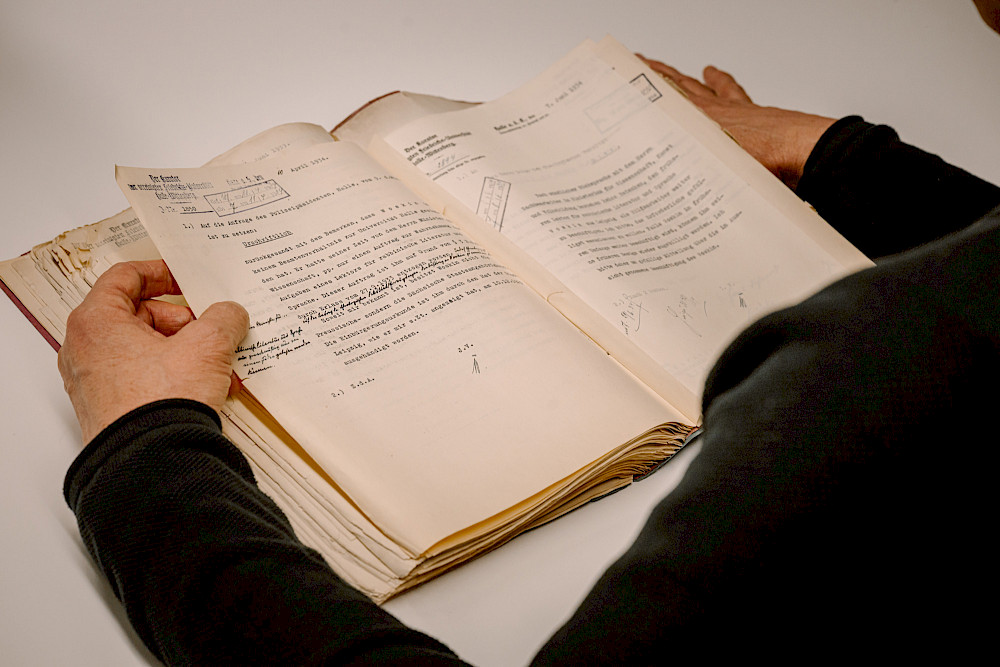
The university’s remembrance ceremony for Woskin-Nahartabi was an extension of the official commemoration of the 43 university teachers dismissed after 1933, which was held in 2013. This was accompanied by an extensive publication containing the biographies of the 43 scientists. The Rectorate Commission, headed by Stengel, is committed to examining the university’s history during the two dictatorships of the 20th century. One of its aims is to compile and publish the scientific biographies of university members affected by persecution.
The commission also focuses on individuals who were victims of political persecution in the Soviet Occupation Zone in Germany (SBZ) and the German Democratic Republic (GDR). In 2019, a remembrance ceremony was also held for these politically persecuted individuals, at which a memorial stele was unveiled on the University Square. The docudrama “Die Zerschlagung des Spirituskreises” (The Destruction of the Spiritus Circle) was also produced in cooperation with Speech Sciences and Media and Communication Studies. The film examines the ban imposed by the Socialist Unity Party of Germany (SED) on a group of twelve secular and Christian scholars at MLU in the 1950s.
“Until now, not enough attention has been paid to the experiences of the politically persecuted, religiously non-conformist or opposition figures in the Soviet Occupation Zone and the GDR,” says Stengel. The commission conducted meticulous archival research on the university’s employees, instructors and students who were subjected to political persecution, disciplinary measures, expulsion, arrest and often prison sentences and in some cases even died in the Soviet Occupation Zone or the GDR. The team was able to document 228 confirmed cases of expulsion from the university. In consultation with the victims, the commission compiled the biographies of 219 individuals who were persecuted in the GDR. Like the biographies of the university staff dismissed during the Nazi era, these were published in the online encyclopaedia ‘Catalogus Professorum Halensis’. “This database is unique to Martin Luther University, and I am not aware of a comparable project at any other German university,” adds Stengel.
The commission’s work is, however, far from complete: biographies are still pending for 190 other individuals from the GDR era, some of whom are difficult to track down. Research on affected employees, teachers and, in particular, students is planned for the Nazi era. The published series containing Woskin-Nahartabi’s doctoral thesis is to be extended by additional unpublished texts, some of which were banned or only exist in manuscript form. “For us, it’s not just about remembering the stories of these individuals. Exposing repression and oppression is a form of democracy education,” says Stengel.
Further information at: www.theologie.uni-halle.de/kg/ friedemann_stengel/rektoratskommission_ aufarbeitung