
Superfood from Saxony-Anhalt

A soft “ding” signals that the dough is done baking. Melissa Arias takes the tray out of the oven and places it on the worktop to cool. On it are small rolls made of millet flour in muffin tins. The day before, she prepared dough from various types of millet, such as sorghum, teff, proso and foxtail, using sourdough, yeast and psyllium as leavening agents. “Now we’re testing the consistency, smell and taste,” says the nutritionist, sliding a sensory evaluation form across the table to her colleague Urte Grauwinkel, on which the data from the taste test will be recorded. The researchers’ verdict is clear: the yeast variant currently comes out ahead. “We still need to refine the sourdough. It’s actually our favourite because the acidification helps improve digestibility and the bioavailability of the minerals,” explains Melissa Arias.
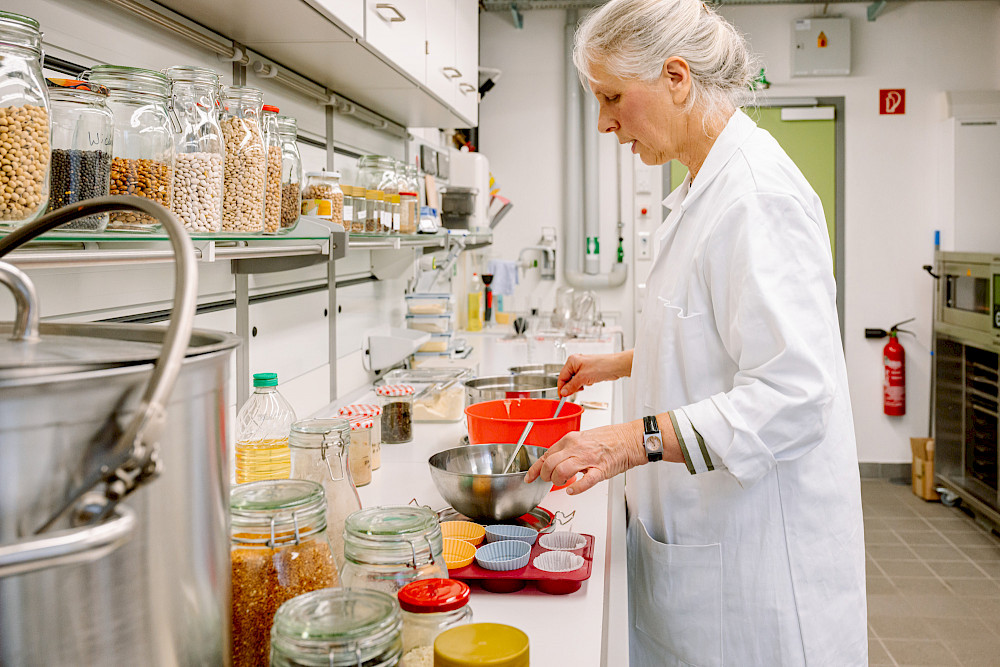
The FoodLab, which contains a fully equipped experimental kitchen, is a part of the “SuSaKlim” project. The acronym stands for “Superfood from Saxony-Anhalt – climate-adapted crop rotations in organic farming”. “We are experimenting with crops that can withstand increasing heat and decreasing rainfall levels and can be cultivated in Central Germany over the long term,” explains agricultural engineer and environmental scientist Urte Grauwinkel, who coordinates the project at MLU. “SuSaKlim” focuses in particular on protein crops, cereals, pseudo-cereals and oilseed crops, including exotic species such as amaranth, chickpeas, chia, psyllium and sesame, as well as native plants such as dried beans, safflower and millet, which have become less prominent in German agriculture. “Safflower, for example, is an ancient crop that we want to revive. The oil contains unsaturated fatty acids such as linoleic and oleic acid and vitamin E. But we are also experimenting with other oil producing plants such as mustard, hemp and flax,” says Grauwinkel.
Part of the “SuSaKlim” concept is that all seeds tested in the experimental kitchen are grown organically on the fields of MLU’s research station located in Merbitz in the north of the Saalekreis District. The project has around two hectares at its disposal for growing the crops. “We have black soil here which is rich in nutrients, but we are located in a dry region in Central Germany with comparatively little rainfall,” explains Urte Grauwinkel. The researchers are investigating crop rotations with protein and oil producing plants as well as mixed crops with cereals and field beans. A lot is surprisingly successful, but not everything; the growing season in Central Germany is too short for sesame, which is mainly grown in tropical and subtropical regions of Asia and Africa. The crop fell victim to the first night frosts in late autumn before it had matured.
But it is not only climate resilience that is of interest – the researchers also want to know which crops are particularly well suited to organic farming with its closed nutrient cycles and natural pest control.
Legumes such as peas and beans are promising candidates here because they enrich the soil with nitrogen, thus creating good conditions for subsequent crops. Because soil quality plays a decisive role, the Soil Biogeochemistry Department at MLU is involved in the project. Soil samples are examined in the laboratory in spring and autumn, providing information about nutrient levels and the composition of the microbiome. Modern digital sensor technology is also used on the test field. “We have installed a probe system that measures moisture at a depth of one metre. We use the data to model how the soil water budget reacts to the crop rotation and under changing climate conditions,” says Professor Bruno Glaser, who brings his expertise as a professor of soil biogeochemistry to the project. In order to assess the vitality of plants under drought stress, plant scientists led by Professor Janna Macholdt are also analysing drone images and spectral imaging.
However, the success of “SuSaKlim” is not solely determined by the yields on the test fields. “We have devised a motto for the project: from the soil to the plate,” says Urte Grauwinkel. In concrete terms, this means that only crops that can be farmed, processed on a large scale by the food industry, and are in demand by consumers have a chance of long-term success. That is why Urte Grauwinkel and Melissa Arias, for example, are working on a millet bread that meets our expectations in terms of having both the typical flavour and consistency of bread. This is challenging because millet does not contain gluten which acts as a “glue” for the dough. However, millet could prove to be a particularly promising superfood because more and more people are having difficulty digesting gluten or cannot tolerate it at all.
Many products created and tested in the FoodLab are the result of close ties with regional farms and food producers. Urte Grauwinkel is well connected and regularly presents the project at trade fairs, exhibitions, markets, farm festivals and industry meetings. For example, the researchers have joined forces with a coffee roastery in Halle to produce a decaffeinated coffee made from chickpeas. And they are conducting trials together with Döllnitz Oil Mill to produce safflower oil. A local brewery has expressed interest in gluten-free beer made from millet malt – there is even a small brewing facility in the FoodLab to conduct the necessary trials. There have also been enquiries about grill patties made from legumes. “When it comes to legumes, we will be looking even more closely at Asian cuisine – fermenting peas or beans into miso, tempeh and shoyu,” says Urte Grauwinkel. All these foods may still seem very exotic. However, Urte Grauwinkel is convinced that the people of Central Germany will turn to them sooner or later as well. And fortunately, she is also convinced that they should not only be filling, but also taste good.
Further information at:
www.dip-sachsen-anhalt.de
The DIP consortium

“SuSaKlim” is one of 19 projects in the “Digitalization of Plant Value Chains” (DiP) project consortium. The aim of DiP is to develop southern Saxony-Anhalt into a model region for a sustainable bioeconomy as a way of contributing to structural change in the wake of the coal phase-out and to provide answers to the pressing questions of climate change.
The sub-projects will investigate what agriculture and farming could look like in the future, which crops will grow on the high-quality, but increasingly dry, soils of Saxony-Anhalt, what the bioeconomy’s untapped potentials are, and what opportunities digital technologies in agriculture can offer. DiP will receive two rounds of funding of up to 105 million euros from the Federal Ministry of Research, Technology and Space as part of Germany’s Coal Regions Investment Act. The consortium, which is coordinated by MLU, has more than 40 partners from science and industry and is expected to run until 2032.