
Strong impetus for healthcare and the economy

A drone whirs over the courtyard of the palliative care centre, powered by eight propellers that can carry up to a kilogram of cargo. It drops a bundle of painkillers with pinpoint accuracy. The medication is collected by a nurse. Then the high-tech device returns to base, whizzing back to the pharmacy “Apotheke am Bauhaus” in Dessau-Rosslau in Saxony-Anhalt. It sounds futuristic, but it isn’t. “This isn’t a vision of the future – it’s current practice,” says Professor Patrick Jahn, who is responsible for nursing and healthcare research at the Faculty of Medicine. “Saxony-Anhalt is the first state in Germany where such supplies are delivered by drone.”
Jahn is coordinating a collaborative project entitled “Translation Region for Digitalised Healthcare” (TDG). It was launched in 2019 and brings together over 100 partners from science, business and society: IT companies, app developers, mechanical engineering companies, research institutions, municipalities, districts, health insurance companies, medical practices, hospitals and nursing homes. They have joined forces in 30 individual projects to look for predominantly digital solutions for the nursing and healthcare sectors. The Federal Ministry of Education and Research (BMBF) had earmarked around 15 million euros for this purpose.
“The south of Saxony-Anhalt is the ideal place to develop healthcare innovations for an ageing society,” explains Jahn. “The average age of the local population is well above the national average. In Halle, the percentage of people over 65 living alone is significantly higher than the national average. This is ultimately reflected by the need for nursing care among a high percentage of the population.” At the same time, the promotion of digital pilot projects has the potential to stimulate economic development – in a region that has been hit harder than others by the industrial downturn, especially due to the phase-out of coal production. And last but not least, Martin Luther University Halle-Wittenberg is one of the leading universities in healthcare and nursing sciences with outstanding expertise in this field.
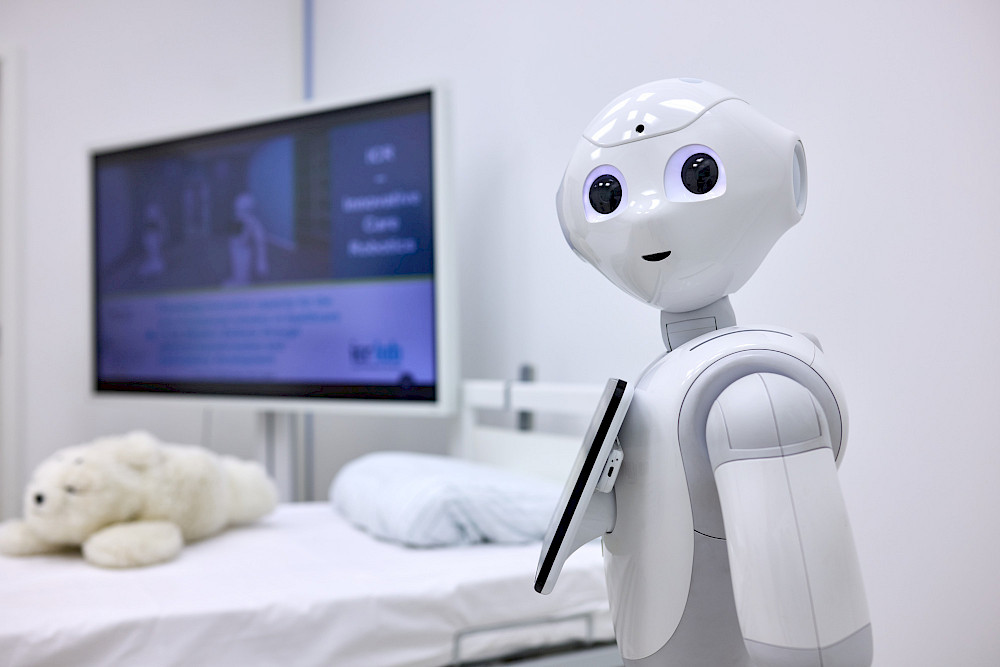
The projects in the network are examining how autonomous living and healthcare can be ensured for older people, especially at a time when skilled workers are increasingly in short supply. “The spectrum ranges from platforms that connect stakeholders and provide knowledge to telemedicine and therapy for specific patient groups, mobility concepts and smart home solutions,” explains Patrick Jahn. The drug delivery drone is just one example of many; in the “AktiMUW” project, for example, the University of Halle is working with Otto von Guericke University Magdeburg and Anhalt University of Applied Sciences on a smart rollator that analyses barriers in the user’s environment, provides voice-controlled navigation assistance and even pays attention to the user’s posture. In another project, “LoRaLAB”, smart technology is being trialled to promote independence at home. Senior citizens from Nauendorf in the north of the Saalekreis district are involved in the development and can evaluate innovations themselves in a test apartment. The TDG network is also investigating how sensor systems and care robots can assist people with restricted mobility and increase their freedom of movement.
“We certainly won’t be able to implement 100 per cent of our ideas, but still, the aim of all projects is to transform the ideas into practical products,” says Jahn. One good example of this is the “DigiKonf” tool, which enables rehabilitation and healthcare specialists to use a virtual reality interface to jointly assess whether an apartment is suitable for paraplegics after they are released from hospital and to evaluate which barriers will have to be removed – without the team of experts having to go to the apartment in person. “As a partner in this project, the BG clinics have already signaled their intention to use DigiKonf for their rehabilitation management in the near future”, says Jahn. The funding period for the collaborative project has now been extended until the end of 2025 to allow the other TDG projects to be completed.
In 2024, the BMBF launched a follow-up project called “Innovation Region for the Digital Transformation of Nursing and Healthcare” (TPG) alongside the original TDG project. The follow-up project is scheduled to run for nine years and will receive 140 million euros in funding. “That’s a vast amount, but then again, we’re talking about over 80 individual projects. Some of them have already started, but the majority are still in the planning stage,” says Patrick Jahn. The individual projects are banded together in regional clusters, each of which has its own key theme. For example, the clusters in the Saalekreis district and the City of Halle are researching the technical principles and application scenarios for digital assistive technologies and robotics. The district of Burgenlandkreis is looking at how virtual and augmented reality can be used in nursing. In Mansfeld-Südharz, the focus is on telenursing, while various projects in Anhalt-Bitterfeld revolve around personalised nursing and networked mobility.
“TPG expands the network of innovative supply chain actors that we built in TDG. We are also creating regional beacons dedicated to specific topics to set an example for future healthcare services for the older generation throughout Germany,” explains Jahn. An innovation office will be set up in each focus region to network the relevant stakeholders and ensure the success of each project. Innovation managers are guiding those interested in getting funding through every step of the process – from generating ideas and developing concepts to submitting applications and managing projects. “The TPG funding enables research institutions, companies, start-ups and social actors such as associations and self-help groups to find a wide range of support and cooperate on innovative projects. Anyone interested is warmly invited to contact the University of Halle or the local coordination offices,” says Jahn.
Although the development of innovations in both TDG and TPG is primarily aimed at improving the quality of healthcare and nursing services for an ageing society, the projects also take into account the economic structural change in southern Saxony-Anhalt. “Strengthening the economy is an important concern of almost all projects”, explains Patrick Jahn. “Start-ups are involved in almost 80 per cent of the TDG projects. Most of them are highly specialised and many have a strong focus on research. We are also aiming for this quota within the TPG network”. Jahn is optimistic that the dynamism and appeal of the innovation network will lead to new start-ups and the establishment of technologically oriented companies in the long term – with high-quality jobs in the future field of digital health.