
Less bureaucracy through digital tools

It is quite simple in theory: When debts are not paid off, a claim can be asserted through enforcement proceedings – provided that an enforcement title exists. In reality, creditors often wait years for their money. This is due not least in part to the complicated network of parties involved: bailiffs, creditors, debtors, courts, solicitors, tax offices, registration authorities and banks. “Enforcement law in Germany is one of the most complex in the world and unfortunately, it is not exactly the most efficient,” says Dr Konstantin Branovitskiy.
The legal scholar heads the “LegalTech Lab”, which was founded in 2024 as part of the “Just Transition Center” at MLU. The lab is supported by the Faculty of Law, Economics and Business and is mentored by Professor Christian Tietje, an economic law expert and a member of JTC’s board. The term “legal tech” is short for “legal services” and “technology”. It aims to design legal procedures more effectively with the help of digital tools. The team has already demonstrated what this can look like in practice through the creation of an online calculator. It allows parents who take turns caring for their children following a separation to calculate their child maintenance claims with just a few clicks. “The tool enables fast and data protection-compliant calculations and can be accessed by everyone involved, not just courts, solicitors and youth welfare services,” explains Branovitskiy. The calculator is currently being tested in youth welfare offices in southern Saxony-Anhalt.
When it comes to enforcement procedures, however, things are not so straightforward. Germany has four enforcement authorities: enforcement courts, trial courts, land registries, and bailiffs. “The latter act on behalf of the state but are not fully integrated into the digital communication structures of the courts,” says Branovitskiy. There is also no standard way to exchange information between the enforcement authorities, on the one hand, and lenders, registration authorities and tax offices on the other. Research, conducted by the LegalTech team, found that, in the course of particularly complex enforcement proceedings, creditors have to submit the same information up to 23 times.
Every year 70.000 enforcement cases land on the desks of the courts and bailiffs in Saxony-Anhalt. Inefficient administrative processes impact structurally weak regions particularly hard, as businesses there usually don’t have enough financial reserves to cope with lengthy proceedings. This is illustrated by the following example: a solar technician from the region of Mansfelder Land installed a photovoltaic system on top of a commercial warehouse, but her client’s bill has yet to be paid. Despite a legally binding court ruling in her favour, she still has to visit various authorities, submit hardcopy documents in one place and upload digital documents in another – multiple times in some cases. The procedure has dragged on for months, during which time she has had to pay for materials and labour in advance. She has also incurred additional expenses for solicitors and fees. But most importantly, while the businesswoman waits for her money, she may be unable to carry out other projects.
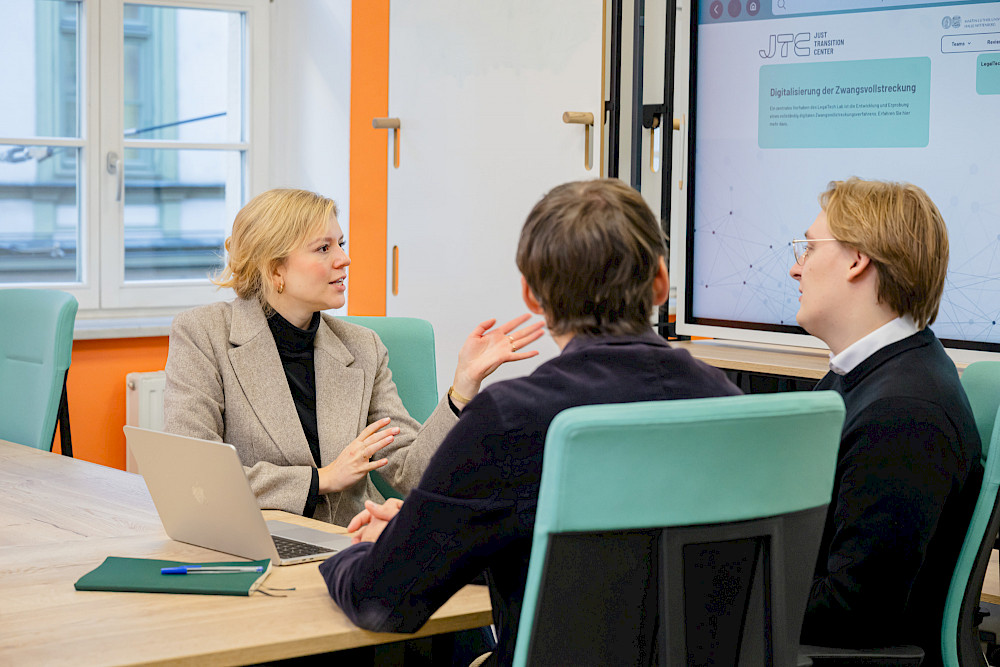
At the same time, enforcement law must also take into account the fundamental rights of the debtor, as it ultimately determines what he or she would be left with to live on, explains Branovitskiy. “It is deceptive to think that the process can easily be condensed – real justice cannot be achieved this way.” Therefore, when it comes to digitising enforcement procedures, it’s primarily about increasing efficiency. In the first step, literature, processes and data are systematically recorded and linked. Key specialist literature is bundled in a searchable online database and linked to sources, main topics and keywords. This reveals new connections and raises previously unanswered questions, such as the enforceability of cryptocurrencies. The “LegalTech lab”-team is supported by Professor Caroline Meller-Hannich, a legal scholar at MLU who has worked for many years in the field of enforcement law and who came up with the idea for the project.
The researchers work closely with bailiffs and the state’s Ministry of Justice in order to learn more about practical procedures. “We would like to create an interactive flowchart that would illustrate the entire enforcement procedure, including all of the processes and data streams,” explains Branovitskiy. “Clicking on a specific process step would bring up all of the relevant information.” While the flowchart is being created, machine-readable code is automatically being generated, too. This can be directly used for tools that offer creditors and debtors legally compliant guidance – and can also be understood by AI systems.
“It isn’t just about preventing media discontinuity or digitising individual procedural steps, it’s about making a process that is over one hundred years old more transparent, efficient and digitally usable – without compromising the high standards of justice,” says Branovitskiy. “The ‘once only’ principle anchored in the federal government’s coalition agreement supports this approach. Once data is submitted, it should be able to be reused throughout the entire process.” In addition to its own projects, the JTC “LegalTech Lab” also supports early career scientists. A dedicated lab area in the centre of Halle provides space for group work and information exchange, with students and doctoral candidates working in various formats on practical issues. The lab is closely linked to the IT&Law doctoral network and alumni are also involved. “The programmes also serve to retain talent here in the region,” says Konstantin Branovitskiy. “In Saxony-Anhalt, the need for well-trained specialists in the field of legal tech is high.”
Further information at:
www.jtc.uni-halle.de
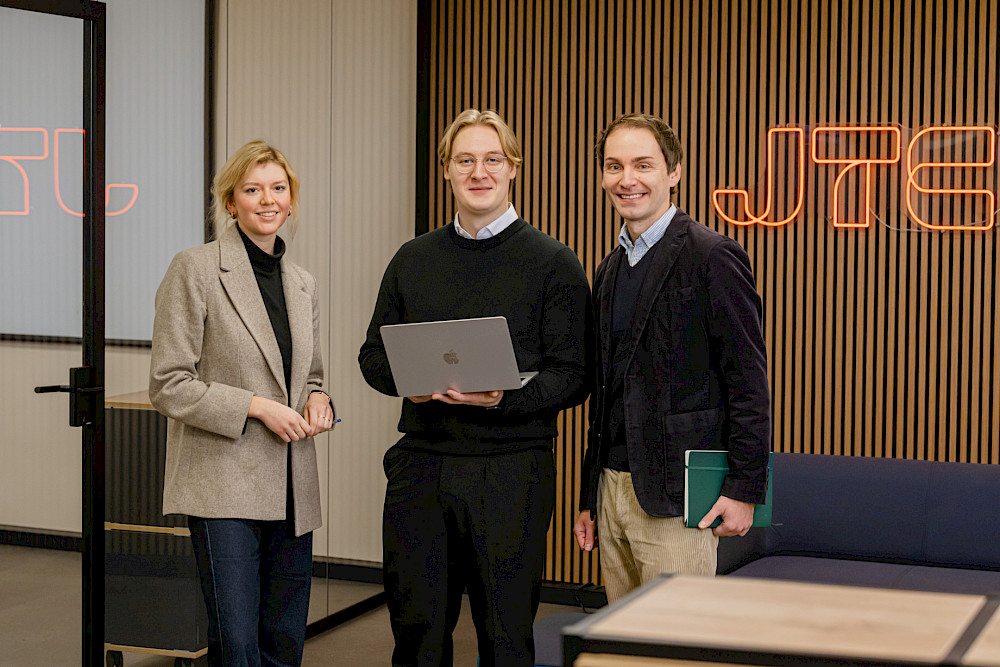
The JTC
The “Just Transition Center” was founded at MLU in 2024. It develops practical and researchbased solutions for tackling structural change in Saxony-Anhalt during the phase-out of coal. Seventeen innovation teams conduct research on socio-scientific transformation and sustainable materials, as well as legal matters and digital solutions in the field of legal tech. In the districts of Mansfeld-Südharz, Anhalt-Bitterfeld, Burgenlandkreis and Halle-Saalekreis, regional scouts build connections between science and the region, and a transfer incubator promotes entrepreneurship, startups and the implementation of scientific innovation. A graduate school connects academic excellence with interdisciplinary exchange and entrepreneurial thinking. Saxony-Anhalt is providing 21 million euros to support the work of the JTC within the framework of the European Union’s Just Transition Fund.