
Strong networks in the Tian Shan region

The Goethe-Institut and the German Academic Exchange Service (DAAD) are close by and the Kazakh-German University is just a few streets away. MLU’s representative office is located here in the east of Almaty, Kazakhstan’s largest city. “With its numerous universities and research institutes, Almaty is considered the centre of science in Central Asia,” explains Dr Peter Liebelt. “It’s a green city with a European flair and open-minded people, and the Tian Shan Mountains are practically on its doorstep. It’s a great place to live and work.”
Liebelt has represented the University of Halle in the former Kazakh capital since 2019. The fact that he is a geographer is no coincidence – the Institute of Geography has maintained particularly close research ties with project partners from Russia and Central Asia for decades. “No German university has stronger ties in this area than MLU,” explains Liebelt. “Which is why we were commissioned by the BMBF to set up CASIB.” The Central Asian Sustainable Innovation Bureau, or CASIB for short, acts as an intermediary between German research and regional project partners – not only in Kazakhstan, but also in Kyrgyzstan, Mongolia, Tajikistan, Turkmenistan and Uzbekistan.
These Central Asian nations are geopolitically significant due to their geographical location and rich natural resources, and because they are a hotspot for climate change. It is therefore not surprising that Germany is eager to create research partnerships with these countries. Joint research projects investigate, for example, natural climate-related and tectonic-related risks, sustainable water management, and resilient agriculture in the dry steppes.
Such projects are difficult to manage from Berlin or Halle. According to Liebelt, “As a local point of contact, we provide information about funding programmes and bring institutions, associations and politicians together. At the same time, we report to the BMBF on developments in the region’s scientific sector, and provide support in organising projects, conferences and congresses.” At the end of 2023, CASIB organised a German-Uzbek Science Day in Tashkent and a German-Kazakh Science Day in Almaty attended by representatives from the BMBF, the German Rectors’ Conference, the German Research Foundation (DFG) and DAAD, among others.
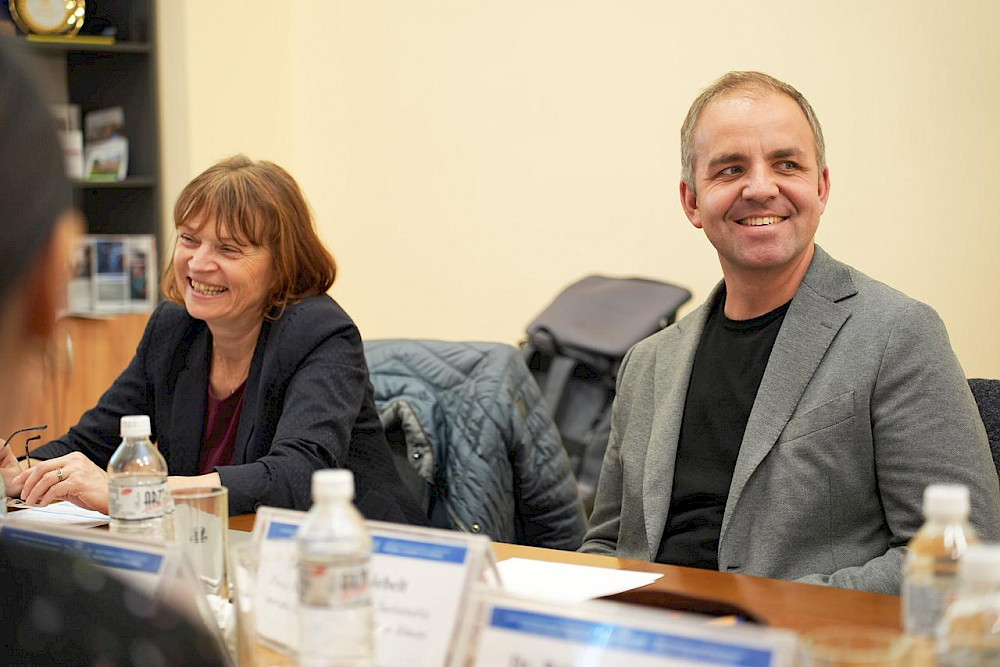
After five years in Almaty, Peter Liebelt has built up a large network. Now, whenever the region’s scientific policy and research collaborations are on the agenda, the geographer is automatically invited – for example by the Kazakh Science Fund. “These are not just official appointments, we are like a big family. We sometimes sit down with the advisor to Kazakhstan’s education minister over a cup of coffee.” Liebelt is also present when German politicians visit the Central Asian countries – such as in June 2023, when Germany’s Federal President Frank-Walter Steinmeier visited in order to find out more about German research projects in the region.
Of course, MLU also benefits from this good reputation. “For example, we are listed here as a top university and are regarded as the first port of call when it comes to fostering gifted students,” explains Peter Liebelt. “This is very much in keeping with MLU’s internationalisation strategy.” MLU’s representative office has now launched a sustainable programme together with the Preparatory College of Saxony-Anhalt. The project plans to bring five young people from Central Asia to the city on the Saale every year. The students are selected together with the Goethe-Institut. According to Liebelt, “We are planning a real feel-good programme: a permanent room in a hall of residence, language training, and support in administrative matters. You need to be inventive when competing for the best scientists.”
CASIB’s work has now been secured for another four years. It’s office in Almaty has received funding from the BMBF’s ‘Eastern Partnerships, Central Asia and Caucasus’ division since 2024. CASIB is planning to organise a Central Asia Forum together with the BMBF to better inform Germany’ scientific community about cooperation potentials in Kazakhstan, Kyrgyzstan and Turkmenistan. The forum will take place in Halle in February 2026.