
A digital treasure from the renaissance

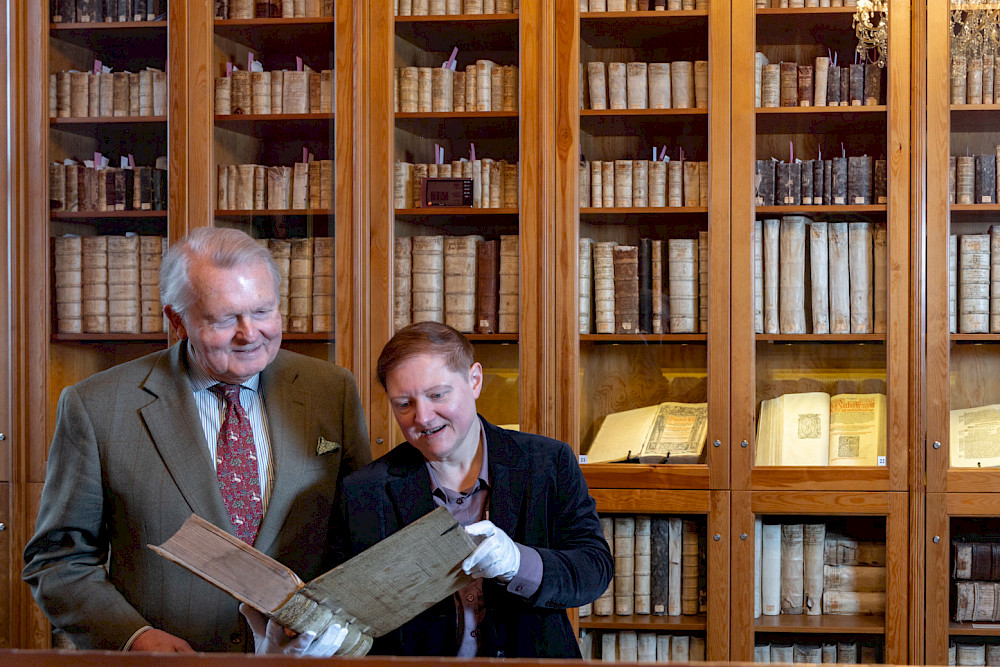
“This volume is exceptional,” says Dr Julia Knödler, who heads the Historical Collections Department at ULB. She holds a 16th-century publication that is bound in a yellowish-brown parchment covered in handwritten text. Research has revealed that the text is a Latin translation of “De materia medica” – a medical reference book in which the Greek physician Dioscorides, who lived during the reign of Emperor Nero, describes the healing properties of plants, animals and minerals. The parchment, of which only fragments remain, can be traced back to the 9th century based on the characteristics of the handwriting. To put it into historical context: during this period, the Kingdom of the Franks was dissolving after the death of Charlemagne, the Vikings had begun raiding Europe’s coasts, and Halle was mentioned in a document for the first time. “Such an artefact is extremely rare and attests to the continuity of ancient medical knowledge in the early Middle Ages,” explains Knödler.
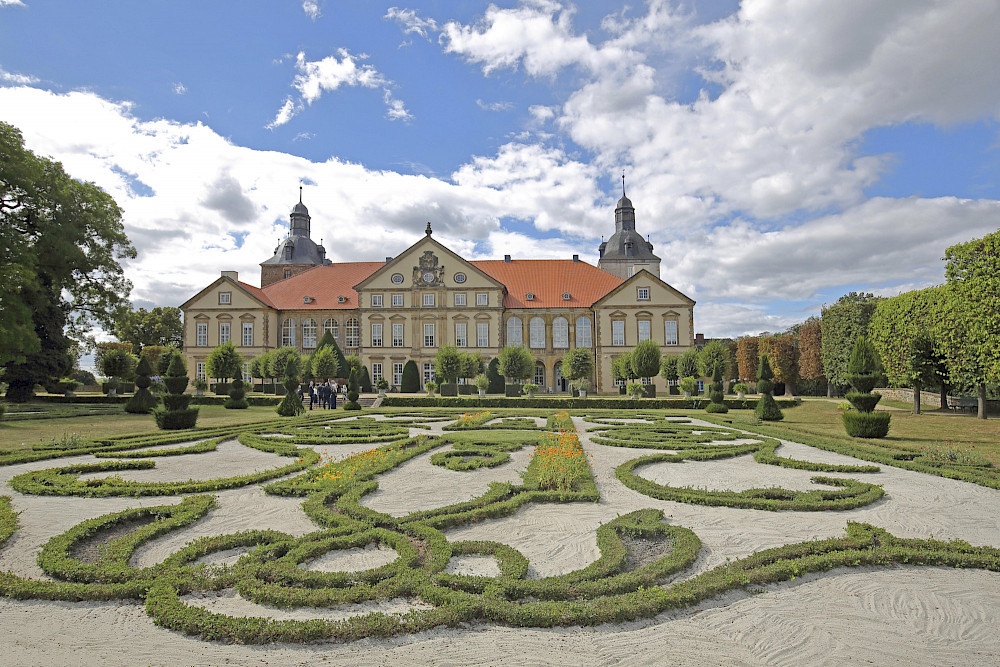
The parchment was discovered at Hundisburg Castle in Haldensleben. Located approximately 30 kilometres northwest of Magdeburg, the castle is home to the Library von Alvensleben – a collection of over 6.000 volumes from the 16th and 17th centuries consisting mainly of theological, legal, historical and scientific texts. The library is one of the most preeminent private collections of Renaissance books in Germany. It was founded by the humanist and reformer Joachim von Alvensleben (1514–1588), an important member of the noble family. Over the centuries the library was divided, expanded, and relocated several times: from Erxleben to Stendal and Hundisburg, back to Erxleben and after 1945 to Loccum and Wolfenbüttel. In 2012, the family transferred the collection to Hundisburg again. Since then, the Library von Alvensleben has been a branch of ULB and scientifically supervised by it.
A large part of the library’s collection – around 3.500 volumes totalling over one million pages – are to be digitised by 2027. The German Research Foundation (DFG) is providing more than 800.000 euros in funding for the project. “We started by researching which works had not yet been digitised by other libraries, because the collection does not only contain unique items,” says Julia Knödler. “Nevertheless, we are interested in any volumes with decorated covers or annotations in the margins, most of which were written by Joachim von Alvensleben himself.” The heirs of the library’s founder, who are deeply committed to the project, also participated in the pre-sorting at Hundisburg Castle. “Digitisation is a big step towards providing public access without having to remove the valuable originals from the shelves,” explains Busso von Alvensleben, current head of the family. “Our collection was, at the beginning of the 17th century, one of the earliest examples of a publicly accessible library. We are carrying on this tradition today.”
The covers and pages are not scanned in Haldensleben, but in Halle. The books, which are up to 550 years old, are transported to ULB in a small van and returned after digitisation. But scanning alone is not enough, because text recognition plays a crucial role in making the library suitable for digital use. Even though the printing press had already been invented by Gutenberg in the 16th century, there were many different typefaces. Here, ULB draws on its unique expertise: “We were able to systematically improve the automatic text recognition process in the course of earlier digitisation projects, such as those involving volumes from the Francke Foundations and St. Mary’s Library,” says ULB Director Anke Berghaus-Sprengel. The digitised versions offer various ways to access the texts: You can either navigate through chapters and sections or retrieve specific passages through a full-text search.
The ever-growing catalogue not only provides access to digitised versions and full texts from the Alvensleben collection, ULB staff members have added notes about the handwritten annotations, special decorations and previous owners, which can be accessed with the click of a mouse. All of the volumes can be viewed online or downloaded in various file formats and resolutions. Research is also carefully conducted on the provenance, i.e. the origins of the books. “Some of the books in the library have a special history,” explains Berghaus-Sprengel. “One, for example, belonged to Johannes Scheyring, as indicated by the notes on the inside cover. It later came into the possession of the Berge monastery near Magdeburg and from there it went to the Library von Alvensleben.” Scheyring was a rector of Leipzig University and later the canon of the Magdeburg and Halberstadt Cathedrals. His portrait, painted by Lucas Cranach the Elder, adorned the German Bundesbank’s 1.000-mark note for 26 years.
Back to the 9th-century parchment: “It was common practice at the time to disassemble manuscripts that were no longer needed and use them as bookbinding material,” explains Julia Knödler. What is certain is that the fragment is not part of the three previously identified 9th-century translations of Dioscorides. The images will now be uploaded to a fragment database in the hope that this will lead to the discovery of further parts of the manuscript. “This would bring together pieces of an ancient puzzle,” says Knödler. “The work of a librarian can be very thrilling.”
Digitalisation at ULB
ULB has been digitising historical publications and manuscripts since the early 2000s. It focuses on works from the 16th to 18th centuries, medieval manuscripts and documents, as well as historical newspapers and geographical maps. ULB has also acted as a cooperation partner for institutions that do not have their own digitisation infrastructure, such as St. Mary’s Library and the Francke Foundations in Halle. Most of this work is funded by the German Research Foundation (DFG). Documents as large as A0 format can be scanned in the digitisation process, and the full-text data that is generated enables precise text recognition and thus easier access for research. As of February 2026, 116.000 books totalling 17 million pages, 250.000 newspaper editions and 1.000 maps have been digitised. The work ensures that these unique materials are permanently preserved and remain accessible.